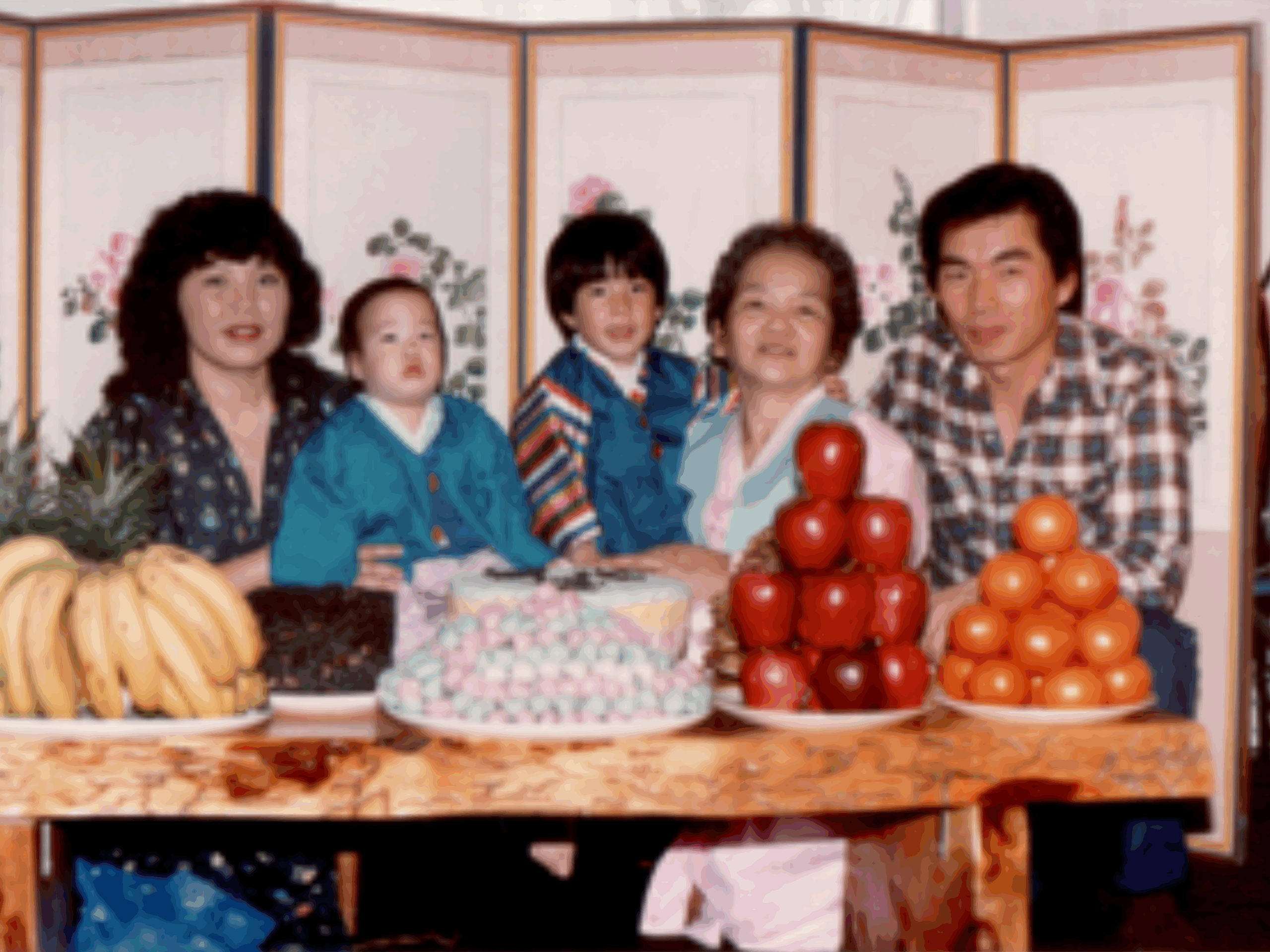
Content warnings: Racism, bullying, domestic violence, gun violence, depression, suicidal ideation, homicidal ideation, school shootings, Christian doctrine, religious conversion, death of a grandparent.
A popular meme format shows a person experiencing a minor inconvenience and calling it their villain origin story. Well, through hilarious mishaps like generational trauma, racism, domestic violence, and depression, this is the story of how I almost became a school shooter. This is—dramatic musical sting—My Villain Origin Story.
Cue peppy anime intro theme as a montage of formative moments from my childhood plays out. I’m Asian American, born to immigrant parents, so you might find some familiar tropes here. I’ll probably abandon this framework metaphor, but let’s run with it for now.
Like most people, I originated from a mom and dad. How this happened is beyond the scope of my knowledge. I know y’all’s parents never had “The Talk” with you either.

Both my mom and dad were born during the Korean War. I know almost nothing about their lives in Korea. My grandparents endured the Japanese occupation before that. I rarely heard stories of the past from my family, due to the triple whammy of cultural, generational, and linguistic divides. And sadly, my window to hear these stories has all but closed as many of the people who lived them have passed away.
Anyway, my parents immigrated to the US from South Korea in the 1970s and settled in a sleepy town an hour from Boston. My paternal grandmother joined us later when I was born. While my parents worked to build a new life in America, my halmeoni pretty much raised me.
A devout Christian, halmeoni prayed fervently that I’d grow up to be a great teacher like my namesake, the apostle Paul. I didn’t even know I had a legit Korean name until high school. So I was addressed as Pole when rendered in Korean, which was the greatest gift my family gave me because the common Korean pronunciation of Paul sounds like ‘bowel’.
What halmeoni neglected to ever mention was how God said of the apostle Paul in the Bible, “I will show him how much he must suffer for the sake of my name.” Paul was martyred in Rome by decapitation, which was fatal back then. That’s called foreshadowing. Not the beheading; the other part.
My upbringing consisted of praying and singing hymns even as I watched Sesame Street and Mr. Rogers with halmeoni. I doubt my parents had any kind of childrearing strategy other than keeping me alive. Even if they had a manual, they probably would’ve just used it to spank me.
By the 1980s, large Korean communities existed in New York and California; not so much suburban Massachusetts. Still, we had a decent-sized church, which served as the religious and social hub for Koreans in the area. I spent every weekend there in Korean school on Saturdays and worship on Sundays.
My early childhood was quiet and carefree, if a toddler’s memory could be considered reliable. The troubles began when I started kindergarten. Enter: white people[1].
On the margins of the Asian diaspora in America, a common intersection between my church friends was being the only Korean kid in school. Universal to our experience was being mocked for our “gross” homemade lunches, the cornucopia of racist slurs, and smorgasbord of physical abuse. What we’d refer to now as microaggressions, regular aggressions, macroaggressions, hate speech, assault…I called Tuesday.
Though bigotry would be a persistent feature of my childhood, I got off relatively easy minus a few douchebag outliers. I found acceptance through assimilation into the majority culture, which wasn’t a conscious rejection of my Korean heritage. Without guidance from my parents, I built an identity on making straight As, winning spelling bees, and being the model model minority. Reinforced by the belief I was destined for greatness from halmeoni, this accidental strategy worked for me.
For the most part, I lived the idealized 1980s childhood, filled with unsupervised bike riding, exploring, and mischief with neighborhood kids. My best friend lived on the other side of the subdivision. We spent our days writing comedy sketches, filming home movies, and creating tabletop role-playing games. Atypical to the white suburban experience were the extended family members who lived with us. My paternal grandparents, three uncles, two aunts, and two cousins used our home as base camp for their own expeditions into America.
* * *
The early 1990s were a hot mess. We had the Gulf War, the LA Riots, and the implosion of my nuclear family.
I can only infer my parents loved each other once. Rather than warmth or anything wholesome, my parents’ marriage was characterized by submission to my dad’s oppressive authority. He was hard as flint but just as brittle—prone to mood swings and brooding anger. The rest of the family adopted strategies of avoidance or appeasement when my dad’s inscrutable gloom pressed upon us.

Displays of affection were stereotypically rare in my family. I don’t remember a time I felt the same tenderness toward my parents as I did for halmeoni. I loved my dad in the sense I feared and obeyed him. My admiration for him was like that of a fan—distant and one-sided. At home, he pursued his own interests rather than spending time with his kids. As for my mom, I held her with the same contempt my dad showed her. Like father, like son.
Going through old family photos, there were clearly times of joy. But any nostalgia for my childhood was overshadowed by the terrors that came.
I woke up one night to hear my mom laughing. A heavy thud from my parents’ bedroom and that incongruous sound again. Not laughter. Screaming.
My younger brother stirred in bed next to me and started crying. Icy fear shocked me awake as my sleep-drunk mind tried to parse the waking nightmare. The silence that filled the house afterwards was just as chilling.
I don’t remember if my grandparents intervened the first time or if that was even the start. My memory of those years rattles around as scuffed fragments tethered together with fraying timeline. Someone, halmeoni or maybe my mom, gave veiled assurances that things were okay, but the violence only increased in frequency and intensity.
During the day, the things of the night were not uttered. By unspoken contract, we each bore the family shame in secret. I coped by compartmentalizing and numbing myself—divide and dissociate. My younger brother didn’t have such defenses, his plaintive wails a regular counterpoint to the screams from the next room. Whatever my dad said was never heard through the walls—only the bitter refrain.
The connection I longed for with my dad was fulfilled in a twisted way as he brought my brother and me into his confidence. He tasked us with reporting anything suspicious about our mom—flirtatious conversations with cashiers, phantom white male paramours, and unplanned stops during grocery runs. My dad kept detailed odometer logs of my mom’s car, having her account for every single mile. His obsession with her alleged adultery poisoned the whole family.
And so passed years of sleepless nights, wondering when the fighting would start. There were the flimsy lies my mom coached us to tell people to explain away the black eyes. How many times can a person trip and hit the corner of the washing machine or fall down the stairs? I don’t know how my mom survived—stripped of all autonomy and under the relentless promise of brutalization.
The presence of extended family in our house did little to quell the abuse. Near the end, my uncle pounded on a locked bedroom door while my mom shrieked “kill me” over and over again. When the door finally opened, a coalition of relatives demanded my dad hand over his guns. Once the words died away, all that remained was the sound of blood being scrubbed out of the carpet.
My mom was in the hospital for several days. When she returned, she convalesced in the bedroom I shared with my brother. I don’t remember where my brother and I slept. Maybe we didn’t, sleepwalking from one interminable day to the next.
A week later, my brother and I were allowed to see my mom. She was unrecognizable—her eyes little more than dark gashes across mottled green hillocks of swollen flesh. Bristling hash marks of stitches formed black hedgerows across her face.
The gossip at church became insurmountable with my mom’s complete erasure from public life, so my dad decided to move. While packing, my mom smashed a plate after my dad threatened to “break [her] fucking skull” for yelling at my brother and me. I made a face that inspired the surprised Pikachu meme decades later.
My mom left first to live with her parents in California. There was never any question of custody. Instead, my dad asked my brother and me about our thoughts on faraway places like Colorado. In the middle of eighth grade, I told my friends I was moving but little else. They threw a farewell party at my best friend’s house. I wish I had confided in them more, but I could scarcely calculate the damage myself.
All our furniture was sold off or given away. What remained was crammed into our Ford Econoline van. My dad, brother, and I spent our final night in Massachusetts at my grandparents’ apartment in an assisted living complex. When they had moved there, it removed a critical buffer that shielded my mom from the battering. Maybe that was by design.
The next day, my grandparents tearfully begged us to stay, but the fallout from my family’s disintegration made existence there impossible. Someone broke into our van overnight, though nothing was taken from the domestic wreckage. We made our way down the East Coast through a gray winter wasteland—away from everything I had ever known and loved.

We were literally homeless as we moved from the gilded cradle of Ivy League universities to what I believed was a pig trough called Georgia. After a week of displacement, my dad found an apartment in suburban Atlanta. We slept in sleeping bags on the floor; the only other furniture a folding table and chairs bought from Walmart.
After enrolling my brother and me in school, the next priority was finding a church. Whether it was genuine devotion or force of habit on my dad’s part, I don’t know. I still prayed and read the Bible every day like halmeoni had taught me, but those things were no comfort at all.
Those years were the absolute worst of my life. My dad couldn’t find a job in his old occupation as a machinist, so we lived off credit cards and menial labor. He worked as an office park janitor at night. I was conscripted to empty trash cans and clean bathrooms, sometimes encountering unimaginable filth. There was no rallying cry to come together as a family. The three of us simply hovered around each other, isolated in our personal miseries.
School was its own circle of hell. I wasn’t so pathetic that I ate lunch by myself; I avoided the cafeteria completely by having a teacher give me a permanent library pass. The casual bullying from elementary school grew more malicious as childhood racism crystallized into more advanced forms. As a scrawny Asian kid in a school with few minorities, it was almost predestined.
Within a year of us moving to Georgia, my dad remarried and divorced, plunging the household again into black tides of fear and abuse. As my life spiraled further, the only choice it seemed I had was how to end it. The morbid daydreaming started with painless solutions like drinking shampoo and graduated to more spectacular expressions: jumping out a window during dinner or hanging myself from a highway overpass. The world needed to know how much I had suffered.
Suicidal ideation turned homicidal as the impotent rage over my lack of agency metastasized. It’s as if the collective Korean angst known as han had mutated in its passage across borders and through cycles of unresolved family trauma. Without a healthy outlet to process this turmoil, I retreated inside again. But instead of suppressing my emotions like before, I let the anger propagate through me completely. The sheer energy of my hateful thoughts provided some illusion of control.
Despite being the primary instigator in all this, I didn’t blame my dad. Instead, within my mind’s domain, the bullies who tormented me made bloody atonement for their sins against me. I wrote satanic verses in English class where demons graphically murdered thinly disguised proxies of my real-life oppressors. In art class, those disturbing stories were made manifest.
A handful of teachers tried to reach out to that withdrawn student, but this was years before Columbine and the tragedies that have become an untreated wound in our cultural consciousness. What would’ve raised red flags today went ignored as I made myself insignificant.
After transferring to another high school, I met a kindred outcast. He was an older student whose long hair, black clothes, and combat boots were an odd pairing with my buzz cut, soccer shorts, and David Robinson Nikes. In grim happenstance, his last name was Cain—like the first murderer.

We talked on the phone after school every day as this unlikely friendship developed. Most of what we discussed was mildly transgressive—like Ouija boards and heavy metal. But not all our conversations were harmless. Along with our fascination with the occult, we brainstormed about all the ways we’d torture those who deserved it: bullies, overbearing teachers, religious sheep, and abusive family members.
Remember the Chekhov’s gun of an actual gun from earlier? My dad kept his guns locked in a toolbox in the closet. It would’ve been trifling to sneak his keys and take them. I had considered this plan before in my pursuit of self-negation, but now that I had a friend, why remove myself from suffering when I could remove those that caused it? Our revenge fantasies were just that without the power to realize them, but a gun is a weapon so irrefutable even a child could kill with one.
But before any manifestos could be declared, any school maps drafted, or any plans of mass murder executed, my friend and I stopped talking just as abruptly as we had started. There was no betrayal or falling out. I never spoke with the boy named Cain again.
Sounds a little deus ex machina, right? But that’s exactly what happened.
Ironically or providentially, I kept going to church this whole time. The church didn’t have a youth group per se—just a basement room where I sat with FOBs, listening to Korean sermons I barely understood from a revolving door of volunteers. Besides the obvious disconnect, church was alienating in other ways, too.
One Sunday, a deaf-mute boy was beaten with a Bible to exorcise the demons that supposedly caused his afflictions. When it was my turn, the supervising adult spoke in tongues and laid hands on my head. I flopped onto the ground to avoid being disruptive. I probably should’ve convulsed a little, too.
Despite pantomiming as a Christian on Sundays, I reveled in open blasphemy the rest of the week for reasons I couldn’t articulate back then. There was no “come to Jesus” moment for me. I was so far away from God he had to do something to save me from myself; He sent someone.
In another winter of my discontent, the senior pastor’s son came from California to our church to lead the youth ministry. For the sake of anonymity, let’s call him Bimothy.
Like me, Bimothy was a second-generation Korean American. He spoke my language. Not just English; he was fluent in Star Wars, British comedy, comic books, and video games. Beyond that, Bimothy saw through the posturing of an emo forerunner and recognized my cries for help.
Having grown up in church, I thought I believed in God. But as Bimothy invested in the youth group, he showed us the love that Christians always talk about but rarely demonstrate. Bimothy made God real for me in a way I had never known. All the things I learned in Sunday School finally meant something when I had everything and nothing to lose.
When I was fifteen, I prayed what’s known as the “sinner’s prayer” in Christian circles and accepted Jesus as my savior. The childhood faith I had rejected became a literal lifeline as the despair over my utter powerlessness was replaced with genuine assurance that things would get better. Sure, it would’ve been nice if my parents got remarried, my acne cleared up, and we won the lottery, but my redemption arc had begun.

The depression and destructive ideation took years to overcome, but I was rescued from imminent and irreversible harm. The faith that saved me spiritually and physically became the foundation to rebuild my life. I survived high school, graduated from Georgia Tech, and got my dream job as a toy designer, working for the inventor of the Super Soaker. But here’s the thing about redemption—the point isn’t to be rescued but made into something better.
Whenever halmeoni told me God was going to use me like the apostle Paul, I inwardly rolled my eyes. I loved her, but she was a Jesus freak who didn’t understand I had other plans for my life.
On the Sunday it was announced at church that I was going to seminary to be a children’s pastor, my halmeoni danced with joy.[2] She went home that afternoon, suffered a massive stroke, and went home to be with the Lord.
When halmeoni saw her prayer of twenty-six years finally answered, it must’ve been too much for her heart to contain. And now she’s in a place where her joy has been made complete.
* * *
This is the story I keep coming back to; the one that anchors me. For genre savvy readers, perhaps this is retconning on a massive personal scale. Maybe it’s confirmation bias—ascribing purpose to otherwise indifferent circumstances. But if God didn’t save me, my story would’ve ended a lot differently. I’d be a tragic footnote in history along with Eric Harris, Dylan Klebold, and Seung-Hui Cho. Even today, the parallels between my life and theirs, down to incidental details, are sobering.
As a Christian and aspiring writer, one of my favorite metaphors for God is that of divine author. Stories resonate with people because God has related to us through stories. Though characters in a story may be unaware of why events unfold around them, the author knows. For a good author, nothing is coincidence.
The simple promise of a story is that at the end, nothing was in vain and the world is better off than when it started. The enduring hope I have as a Christian is that at the end of humanity’s story, all tyrants will be brought to heel; all injustices redressed; and all suffering will not only be undone but redeemed. I strive to live in light of this hope even as I try to make sense of a seemingly senseless world. My story isn’t over, but I trust the ending is good.
There’s value in sharing our stories even if we come to differing conclusions on what they mean or if they mean anything at all. I share my story in the hope you feel solidarity in the intersection of our experiences. Maybe you learned something about yourself or the people around you. But maybe connecting even in this small way, we added a little good to the world.
[1] To be fair, my first friend was a white kid named Harry. He was neither dirty nor a wizard.
[2] My grandparents eventually followed us to Georgia. Circumstances led to the former children’s pastor and my mentor, Kenneth Bae, to leave our church. He would later be detained in a North Korean prison camp for two years, but that’s his story to share.


Paul, you are an amazing writer. I am so sorry you went through what you did. I cannot imagine the level of fear and trauma you, your brother, and your mother felt. I am glad you are experiencing redemption through your own family.
Your true-to-yourself wittiness and vulnerability led me through a plethora of emotions, for sure. All the while reading, I wished I could give a pat on the back to the boy in the picture and tell him that God’s goodness is waiting for him. Thank you for sharing in this way—🤍
I just read your story while sitting at the dentist office with my daughter and was literally LOL and then crying and LOL again, looking like a crazy person while they were cleaning her teeth! I love that I’ve gotten to meet you and know you before reading it so I was able to contrast your story with the funny, quirky guy you are now. And knowing the beautiful family you have just made it hit even deeper❤️Thank you for being so #asianopen and vulnerable. It’s such a clear picture of how Jesus meets us in the darkest places and brings redemption and hope. Hope to see more stories from you on here, Paul!!
I’ve always loved reading what your write! Thanks for sharing your story! Looking forward to more.